The idea here is, people can be reasonable when it is worth it; and more, people can learn what is worth learning. Could we have a math integral indicated in a constitution?
I thought about it doing my exercise on Republika Polska, about country finance with mass robotics, when most jobs as today are gone.
Virtual country
Exercise at Democracy
Mathematical integrals have been in use since Antiquity. Today, people have them to calculate average values of curves, and those can graphically represent finance; or, to reckon on antiderivatives, as to help tell sums of finance that can be granted. You make your integral definite, to set a limit.
Mathematics is proper to talk cash. Country accountancy would be mostly 2D, and the bulk that is printed as currency would favor three dimensions. Integrals look natural here. They can do 2D and 3D.
If to argue that math is difficult, let us consider, constitutions were altogether difficult in Antiquity because people could not read or write. In Egypt, feudal pharaohs even held writing for sacred, all the plenty of pictures to tell the people not to bother even trying to learn. Today, literacy is the standard also in architecture, and math cannot be too much of a peek into the future. It is learnable.
What is the future to bring? Robotics is already here. Robots can make food and serve it; print houses; make clothes; construct automobiles. The future of humankind is in creativity. A nice future, if you organize it right; potentially yet a nightmare of poverty.
Boom and bust have made history. The ■List of stock market crashes shows that what goes up, will go down, unless you have… “something”. Sustained improvement has also happened on Earth.
What is that “something”? Cash has worth when there is free market turnover and a sustainable standard of living. More or less, this is how one Franklin Delano Roosevelt saved America, suspending the parity that metal as gold could bring.
Why have a metal reference for money? Gold is of a price. That price could be manipulated with bringing more gold into the market: a thing not impossible, but not very likely. This is all, for the parity of gold. A more or less stable monetary reference for value (yes, it is the value of cash to tell how much for the gold).
Therefore, what we need for a good currency is reference. For people and country economies, gold does not really have the spirit. There is not even a thread of it in a banknote. All the worth of it for country cash is calculated math in fact. This is why Roosevelt got away with suspending the reference, and possibly it was economically ominous that his remedy worked: gold serves only those who have stashes of it.
We are thus not going to blame paper money. A ruler known by the name of Julius Cesar agreed to have copper coins. Anyone with a copper stash big enough might bring the value of his coin down, should the value be in the metal, because the more common, the less worthy metals become. Should the worth of the coin be in the side that shows the ruler’s head, you might as well print that pattern on paper.
When is it reasonable to print cash? Empty print can only result in inflation. You need two or three sheets of paper in the place of one, no other outcome has ever happened, also in Poland; but if there is a good turnover and standard of living, you can provide the money bulk. Print has worth.
I do not even imagine thinking about this without math.
There is probably nobody capable really to mind each and every paper note, be it a Washington or Franklin, and still, things need to work out, because every day people exchange the paper-printed value for goods, and goods for paper-printed value.
With robotics, some ideologies might claim there are too many people, because robots can do the jobs. I have read a theory about wars having been a “natural regulator”, well, not to detail, because the attractive idea is that people are not too many, as we always need “that something” — a market economy and turnover; the more people the better, that is, with a good standard of living of course. It’s a pity no resource of that sort has fallen in my hands yet. The world yet needs to write up about it, where people think about standard of living safeguards and capitalism.

On a desert island, you maybe could find some treasure, but without a country treasury — all the worth you get from that find is your looking at it, because you can’t sell or barter anything, without a market.
It would be unreasonable to seek all fulfilment in looking at things found, yet you might still imagine thunder: Are we to be back to Communist idolatries?
Nope, whatsoever. Communism as in Poland failed beyond doubt. There was neither food enough, nor toilet paper.
We do not imagine individual businessmen either, as they reject robotics just in order to employ people. We do not go advocating gold nugget infinitesimal proportions for represented worth: it is a fair question, for any government to answer, whether hereditary or representative, what there would be in that gold stash to show for a citizen, because there is no country if there is no money — and people.
“Commodity-monetary value” continues its career in economy, whereas robotics is flexible production; it could be tweaked any time, especially 3D print. For money to keep worth, a math constitutional parity might have trust enough: you can’t change it fast and in secret. For the market not to be too centralized, regional taxation would respect arrays as set with regard to local turnover.
Good ribbon is good, but you need the haberdasher’s.

Thus we do not envision the robotics jobless and poor people, pouring into town and city streets in search for food. We do not portend a world conflict. It would be monarchy foreign spending on the war in Ukraine to occasion the thought more, where the UK with ■100 thousand free drones say they would like to learn from experience; a cruel idea for learning it is, where the NATO Secretary General, Rutte is a historian and a Dutch one, to side with monarchy.
Progress with capitalism might mean a “turnover dividend”, if you like the shortcut label for a process. The preferred form of government is the republic, and the theme is evergreen: would there be money in Heaven?
“Whatever your picture for the future on Earth, the Great After is not likely to have factory shift employment for souls, said Honeybee, whereas if you know how to go about it, monetary currency is simply convenient; way better than barter. He imagined, in the Great After, people would trade arts and fashion in a huge market.”
ADVERTISEMENT

A tale of counsel inspired with reading about Confucius
Honeybee said, it is precious, the reason to live and exist given us from Heavens to be intrinsic love in us all, in every human being. Agreeably to get along with this intelligent idea on Earth already — is in our best interest.
If a country, region, or state were obliged to put cash aside in proportion to country, region, or state market turnover — that would allow good printed cash in the end of a cycle — the percent, from whatever the agreed financial instrument, could provide for payouts for citizens. Money at this large scale certainly is math.
The financial sum total in country yearly turnover remains difficult to find over the Internet, but for a comparison, the USA GDP was 27720.71 billion US dollars in 2023. Think, every state is obliged to put aside money in proportion to its turnover, place it in a bank, and pay the interest rate to citizens?
Irish surplus for 2024 was to be about 8 billion before ■the Apple tax, some 25 billion in sum total according to ■The Irish Times, whereas citizens of the country are some 7 million — enough to put a million for each person in a bank and give them dividend payouts. The people would spend the money and “do the magic” — turnover. Without any preferential rates, the amount could be some 400 euros extra a month, or about 4,800 a year. Of the 5 thousand total, as with the Bank of Ireland for example, the government people would deserve pay on top of their gain as citizens.
As long as bank investment is legal, in proportion to turnover and at a bank basic rate per year, it would be no empty or fake to print some cash. Were we to live by the bulk of print cash as at the times of Benjamin Franklin, we would have to go barter, because there would not be enough banknotes.
One percent of 27720.71 GDP would be 277.2071, and the state would not have to withdraw the cash from the bank. The turnover is obviously a higher number, so it would be likely a fraction of a percent to discuss and begin with, in terms of turnover and standard of living payouts. Some of the money, the state would keep: legally and well paid, the government is likely the best.
I say, ■The Hunger Games primarily are lacking in mien.
“The President receives during his or her term a remuneration to a published amount, which sum shall not become diminished during his or her time in office; he or she shall not receive any other emolument, neither from the Republic nor from any private venture, domestic or foreign.
The exception is the motivational bonus equal to that received by the governor, in a Region of head of state choice that is not the Region of head or state residence in elections; no Region may remain presidential for a time longer than four years; each Region may become chosen again after twelve years.
Governor motivational proportion is a financial triple of a definite integral where the plus value is the average standard of living payout in an annual amount, a unit of currency for a mathematical integer.“
It is no wager; it is no bet. Though the constitution would not prescribe or tell more, people might learn and make sense, if it would be worth doing. Constitutional and mathematical functions could become of use in trade, domestic and international, like parity, only independent of metal and more flexible. You cannot depend on magic all the way, you know.
My constructive exercise at democracy occurs also in free posters.

Republika Polska PL, Page 1

Republika Polska PL, Page 2

Republika Polska EN, Page 1
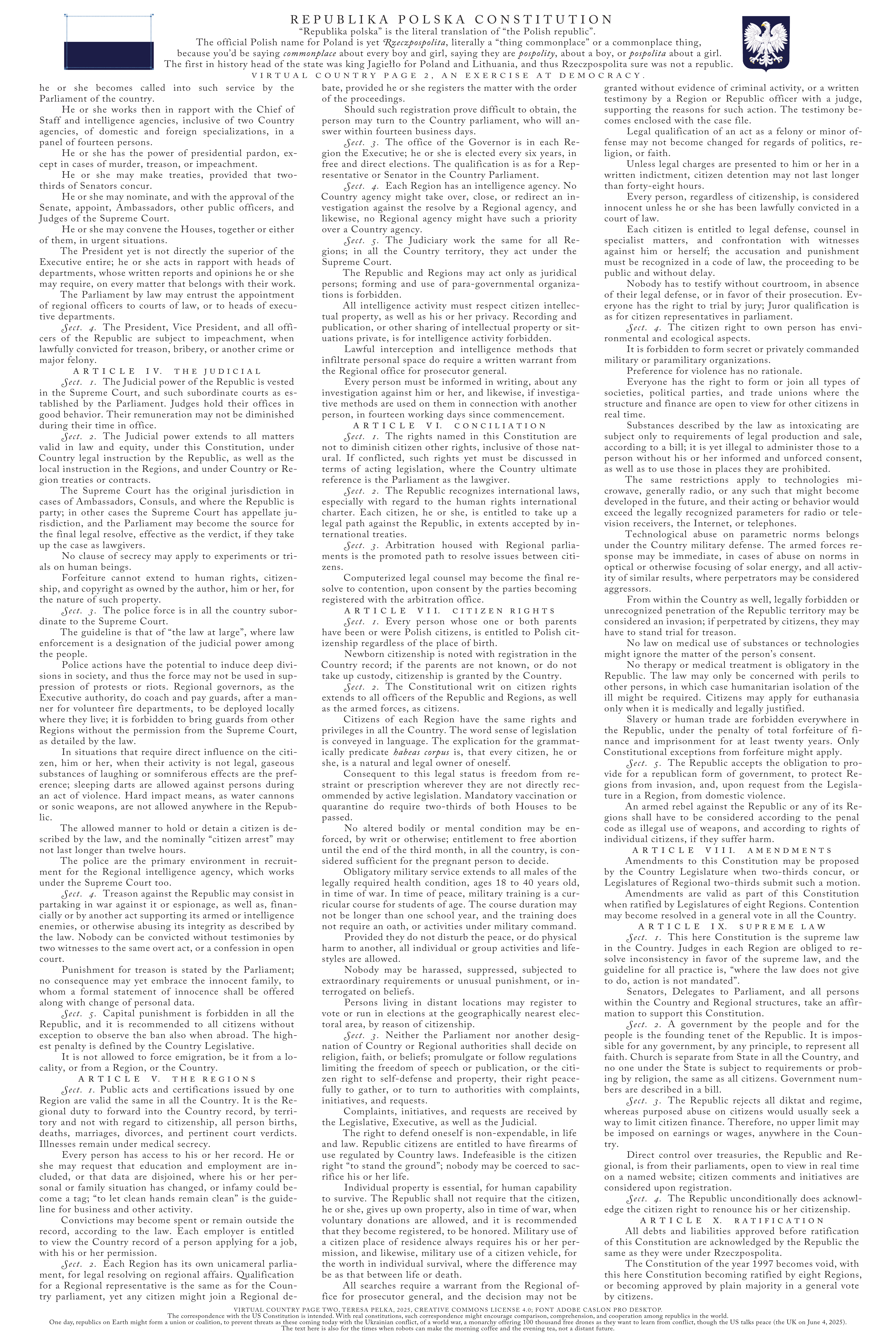
Republika Polska EN, Page 2
Let me emphasize, the above is an exercise, to see what a thing as an integral would even look like in such a body of text. The posters and PDFs are for any discussion to be peaceful and open.
Now, after a brief comment on the Irish government allowing Down Syndrome people voting, — which is, 99% of the people report a mental dysfunction — I would like to focus on my critique of the Polish constitution.
The Polish Constitutional Tribunal is my resource of choice, as they are the country legal authority and as such, force in the matter, they present an acknowledged translation to English.
■the Polish Constitution in English;
■the Polish Constitution in Polish.
My first and usual reservation is, the Polish Tribunal translates “ojczyzna”, fatherland, as homeland. Fathers are not houses or homes, whereas it is important that one can associate the country with simply a good roof over own head. Polish does not have a word for “homeland”, feel welcome to read, ■The toolbox Poland.
The Polish Rzeczpospolita, verbatim, a commonplace thing, is translated as a republic, though the head of the first Polish “republic” was king ■Jagełło, and thus the country obviously could not have been a republic. You’d be saying they are commonplace, about every boy and girl, saying pospolity about a boy, and pospolita about a girl. There’s no way around it. There need to be citizens.
The Polish act of 1997 does not properly recognize the Tripartite. Article 169 creates a “legislative-executive”, for Polish “self-governments” to perform their duties through constitutive and executive organs.
The President is defined as the supreme representative of the Republic of Poland and the guarantor of the continuity of State authority, the word “executive” to occur in Chapter 5, only in the phrase “executive orders”.
Chapter 1 already introduces an exercise of power known as mobocracy. Article 4 says, the supreme power is vested in the Nation, and the people can exercise that power directly.
Chapter 1 Article 10 reports on the Tripartite in two sentences, and absolutely nothing with regard to the country would follow. Article 11, right next, tells about political parties.
Article 18 states that marriage can be man and woman only. I was disgusted with the idea by Elton John, for him to be father and his male partner to be mother (a!), but otherwise I have nothing against homosexual people getting married. No state should force quasi-legal resolves.
Next, Poland promises help to veterans. A loose bundle of notes, it is (■Article 19).
Constitution preambles are not the law, only the articles make it, yet it is the introduction to clarify, the act is not the supreme law of the land: it is a basic law. Let me note again, the translation is by the Polish Constitutional Tribunal, and thus there could not be a translation more ■sworn, or fit for legal purposes as well.
We, the Polish Nation — all citizens of the Republic, both those who believe in God as the source of truth, justice, good and beauty, as well as those not sharing such faith but respecting those universal values as arising from other sources, beholden to our ancestors for (…) our culture rooted in the Christian heritage… Recognizing our responsibility before God or our own consciences, hereby establish this Constitution of the Republic of Poland as the basic law for the State.
Poland has been divided on ground of faith for decades if not longer, and the idea here adds emphasis.
I was not there, when the people were talking about good looks. Beauty with regard to human beings has been mostly perceived as feminine, and now the implication must be to subject male grooming to normative acts.
The idea for country finance is a “social market economy”, not a free market (Article 20 of Chapter 1).
Establishment of religion requires an agreement with the Council of Ministers (Article 25.5).
Article 30 describes human dignity as “inviolable”. Neither armor nor fortress would be provided for, and this might be why most people prefer the adjective “nonexpendable”.
Article 31.1. says, Any limitation upon the exercise of constitutional freedoms and rights may be imposed only by statute.
In other words, statutes are the supreme law of the land.
31.3. says, such limitations shall not violate the essence of freedoms and rights.
Not knowing what the essence is, because the constitution does not explain, we learn that violation might be allowed by means of statute. Constitution is not the supreme law.
Article 32 has the legendary pun, all people shall be equal before the law where the word, before, can refer to place or time as well. Dan-to-Beersheba would describe a Polish tradition.
I have no reservations about Article 33, I only think why the British spelling for honor (this is where the spelling comes from, England).
The US constitution has the form shall, and it differs from British, because it is not about strong and willful resolves. Phrases as crime shall have been committed do really tell, if this happens. American has the modal form will, for resolves.
The Polish Article 40 says, The application of corporal punishment shall be prohibited. With the British spelling for honor, the wording makes a future impression: shall be prohibited is not the same as are prohibited., and the Polish Constitution is not about establishing a new country.
Article 34.1., Polish citizenship shall be acquired by birth to parents being Polish citizens.
If your father is just a man, and your mother just a woman, it is not enough; one day, in the future, you’ll get your citizenship…
Article 34.2: You cannot lose your Polish citizenship, and the Constitution says you can renounce it, only to add, if the President allows, see ■The toolbox Poland.
Article 39, a number sensitive a bit with most people from Poland, as WWII began with invasion on Poland in 1939, says, No one shall be subjected to scientific experimentation, including medical experimentation, without his voluntary consent.
Why is it people prefer informed consent? Why is it people prefer his or her, rather than his solely?
The sexist bias (as of year 1997) continues throughout Article 41 — and what are women to do about unlawful detention? — where the perils of the modal form “shall” do hold.
As if to help get away with unlawful detention or corporal punishment, Article 42 would punish an act, and not the guilty person; it says, punishment of any act.
Article 42.3. makes sure that everybody is “somewhat” guilty: Everyone shall be presumed innocent of a charge until his guilt is determined by the final judgment of a court.
The article might add, however long it lasts, to determine?
Crime is crime unless political, says Article 44, where Polish and English take different paths: in Polish the legal expiry is suspended for the time the political causes existed, and in English the expiry becomes extended by the time political, whereas people have said time is money since beginnings immemorial.
Which do we extend or suspend, money or time?
The statute of limitation regarding actions connected with offences committed by, or by order of, public officials and which have not been prosecuted for political reasons…
What could there come to mind… The “magic number” 44 of ■Dziady by Mickiewicz, for the reason it has not been disambiguated; or, as with Kai and Gerda (■Snow Queen), maybe a time comes, and you look into each other’s eyes, and all at once you understand; or, should people insist it takes time to grow up, you may read ■some Gałczyński, that some with goldfish and lingering old times.
48 says in English that Polish children worth counting are boys (in Polish there is the matter of the grammatical gender for the word dziecko, a child). Parents shall have the right to rear their children in accordance with their own convictions. Such upbringing shall respect the degree of maturity of a child as well as his freedom of conscience and belief and also his convictions.
Article 62 allows a broad idea of “legal incapacitation” in English, in the place of the Polish power of attorney, where “assisted decision-making”, as with moving about too, would belong with incapacitation and yet not mean insanity. Some veterans might use assisted decision-making, and there probably should not be any “blurry legal area” anyway.
Article 64 has another enigma in English, about personal property: The right of ownership may only be limited by means of a statute and only to the extent that it does not violate the substance of such right.
Before, we had an essence of a right. The substance added, Poland would be saying it cannot be trusted.
The side effect is, my math in the Constitution looks much more of an understandable thing.
Article 65 says, Everyone shall have the freedom to choose and to pursue his occupation and to choose his place of work. Polish has the antecedent correlating with the plural.
Article 85 makes the preliminaries for military conscription of women: It shall be the duty of every Polish citizen to defend the Homeland.
Fortunately here, the Polish can be taken for strictly masculine.
Article 87.2. assures the Constitution is no supreme regulation: Enactments of local law issued by the operation of organs shall be a source of universally binding law of the Republic of Poland in the territory of the organ issuing such enactments.
Since constitutions generally yet are expected to be supreme regulations, George Orwell may come to mind, “Doublethink means the power of holding two contradictory beliefs in one’s mind simultaneously, and accepting both of them” (1984).
Orwellian looks the style of Article 88, The condition precedent for the coming into force of statutes, regulations and enactments of local law shall be the promulgation thereof, where the Polish says you need to publish the bill to have the law. Not a word that would go with milk (Latin ■mulgeo).
Politics is continued as a game of tag on crime, in Article 105: From the day of announcement of the results of the elections until the day of the expiry of his mandate, a Deputy shall not be subjected to criminal accountability without the consent of the Sejm.
The Executive is allowed to shut the Legislative down in Article 155; it is enough to pick the candidates: In the event that a vote of confidence has not been granted to the Council of Ministers pursuant to para. 1, the President of the Republic shall shorten the term of office of the Sejm and order elections to be held.
The State Treasury shall be the milking cow, says article 167.2.: The revenues of units of local self-government shall consist of their own revenues as well as general subsidies and specific grants from the State Budget.
State monopoly might embrace anything, says article 216.3: Any monopoly shall be established by means of statute.
All the talk about money has been yet more or less redundant. The worth of money is to be decided by a single bank: The central bank of the State shall be the National Bank of Poland. It shall have the exclusive right to issue money as well as to formulate and implement monetary policy. The National Bank of Poland shall be responsible for the value of Polish currency, says Article 227.
Articles up to 233 tell about extraordinary measures, as with martial law, natural disasters, or war, for 233.2, right next, to qualify atheism or disbelief as a lack: Limitation of the freedoms and rights of persons and citizens only by reason of race, gender, language, faith or lack of it, social origin, ancestry or property shall be prohibited.
Polish national antagonism is far from gone.
Article 234 recurs to martial law, to tell the Parliament are to be there to approve, strictly: Whenever, during a period of martial law, the Sejm is unable to assemble for a sitting, the President of the Republic shall, on application of the Council of Ministers, and within the scope and limits specified in Article 228, paras. 3-5, issue regulations having the force of statute. Such regulations must be approved by the Sejm at its next sitting.
Article 235 denies amendments as part the constitution; they can only be statutes: After conclusion of the procedures specified in para 4 and 6 above, the Marshal of the Sejm shall submit the adopted statute to the President of the Republic for signature.
Finally, in my exercise, I thought the Constitution should forbid in country administration any names for places or addresses that derive from practices demeaning to human rights. Katowice are a Polish classic here, as most people would derive the name from a word for a torturer-executioner in Polish, kat.
Historically, some such establishment was there, under the monarchy. Some resources would tell that kat was a word for a settler, only it was originally kąt, like a Polish word for niches and nooks. Well, it must have been then, it became kat in Katowice only, which town is in Śląsk, and that name has not lost the ą whatsoever. Most of the ą and ę remain, as they arrived from France around the time of king Jagiełło.
Any etymology I have been able to find yet says, kat has been for torturer-executioner.
Feel welcome to read and discuss,
■Republika Constitution in English;
■Republika Constitution in Polish.

For country, money, and math, inspiration might be simply something that gets you in a good mood for thinking, while it sits somewhere in view. Take it the good way, like Confucius advised. 人段 is the human factor. Creativity can be the future of humanity, possibly with the irrational and transcendental ■Gelfond too.
ADVERTISEMENT
A tale of counsel inspired with reading about Confucius
Honeybee said, it is precious, the reason to live and exist given us from Heavens to be intrinsic love in us all, in every human being. Agreeably to get along with this intelligent idea on Earth already — is in our best interest.

 TERESA PELKA.COM