Most people on Earth have heard the name. Nobody has seen the man, as all people who have lived since may have seen styled images only, of William Shakespeare.


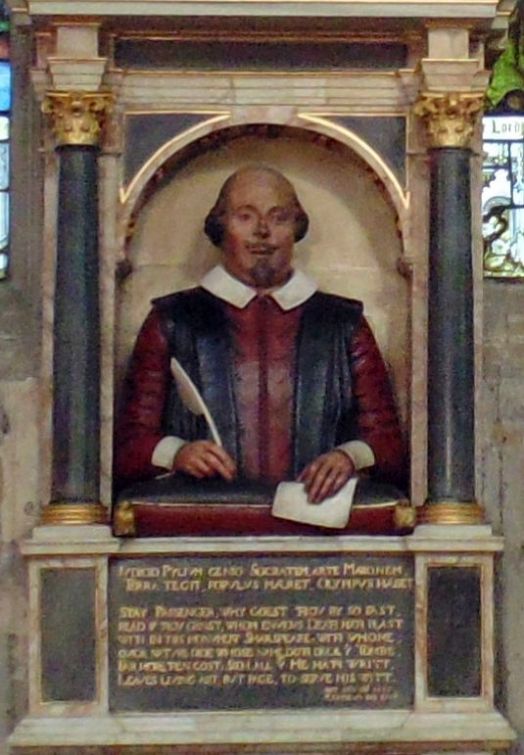

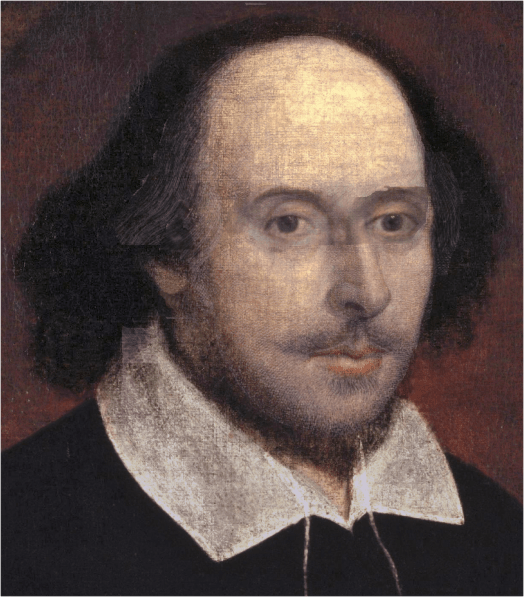
■John Taylor, the same as Millière it seems, hardly painted anybody except the one famous person. The ■Chandos portrait is heavy with Iberian features and the painter evidently “bestowed” the writer with some of own sore and tired facials around the eyes.
I like to have it for a possibility at least, that Shakespeare walking the streets of Stratford on Avon did not have people wondering what Spaniard might have brought him around. Likewise, matters were possibly at least more favorable to himself also in London.
With regard to the First Folio, I find it difficult to imagine the printer would have been unaware of ■Dürer, where all the woodcut has one thing in common: while attending to proportion, it is altogether not complimentary on human stature, also psychological. Nonchalance found its way into Dürer’s oil paint as well, regardless of the theme; whereas his Expulsion from Paradise brings me the thought — things were maybe not well some time, but why so much on the bottoms.


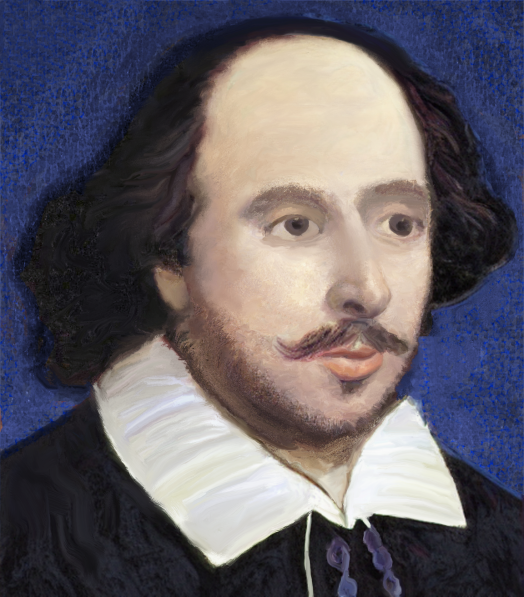
The Stratford sculpture is no Vinci, but it has this 3D factor that helps reckon on a face. I have put the three images one on top of another, flipped — to distance myself from the styling — and reckoned on a guy who would look regular in places upon Avon as well as Thames: there is no extant description on how or what Shakespeare looked, and there would be, had he been out of the regular in any way. Shakespeare evidently looked like the folks you could see in the street every day.

Here is my result (Corel PaintShop Ultimate and Painter), more or less (work in progress) — quite an agreeable fellow, I’d say. Feel welcome to read about ■Thomas Paine as a young man too.
I believe William Shakespeare was one person. Why, if you get stories it might have been a nickname for a team? There is one very common-sense argument. The language of his plays is interpretable. If a language style is interpretable, it is certainly learnable. The argument is not to say I am good as Shakespeare or that anyone is. It is to say, if I can learn some, why should I doubt there was a person as Shakespeare and able? Nothing and no one can ever really be too good to be true. The language matter exists, so it has to be real. Feel welcome to my exercise at ■transcreation on Anthony and Cleopatra.
Shakespeare’s works imply a very good lexicon, Greek and Latin. The matter is the same about Emily Dickinson or Carl Sandburg. I can say as a philologist, there must have been a resource that addressed human belief about development of languages on Earth, and those great authors had access to that book. They learned. Maybe there were only a few copies.
I do not know what resource it was and if it is available anymore, but it had to be a book about words. Mythologists might try to guess it could have been the legendary Comedy by Aristotle, but then, the book could not have been comedy only. Today ■Bailly might compare, but it is Greek to French and much later, so it would compare mostly for volume and room with the Greek detail.
A book of good assistance, it must have been. Let us compare Bailly (2192/2193 ) ωφελημα, ofelema: ce qui rend service, chose avantageuse, source de profit, bienfait — that which provides service, αν advantageous thing, source of profit, benefit; and I believe Shakespeare was a playwright.
Feel welcome to my ■Resource on poetry by Emily Dickinson, by the way. Type in “correlat” in the search field, for correlate or correlative. The mysterious manual would have told how to make things literary of words. Well, Webster enclosed some introduction too, for 1828. To say there must have been a resource, I do not intend to demean the writers: still, you need to have a mind, to use that book at hand.
Let us take another example from a book about Confucius. The ■Morals are later than Shakespeare and his Anthony and Cleopatra (cf. my ■transcreation), but both elaborate on a language item, buckle or buckler. Feel welcome to the ■Fable of Philosopher Honeybee, for my view on lore, Confucius, people, and the world.
Language-wise and for the story of Confucius too, matters yet would wind up back to Greek as earlier than Latin in telling the color of the sky: coelum or caerulieus as derivative — ■cerulean today — indicate an origin where {k} was the word-initial speech sound, as in the Greek ■κειρύλος (keirulos). The oe had a mute o in Latin and it read as e, but c was pronounced as {k} before o or a, on a regular basis (■Latin demeanor). You still say kapita and selestial in English today, owing to the fact — brain is wider than the sky, Ms. Dickinson wrote.

It is not only for her ■I asked no other thing that we may like to try the Perseus tool for Latin and Greek (■Notes for Emily Dickinson’s poetry). It is certainly no coincidence.
■perseus.tufts.edu/hopper/search.
Sample searches:
■Greek morpheme -lus
■Greek morpheme -luo
■Latin morpheme -lus
■Latin morpheme -luo.
I thought also for Shakespeare, I was finding the matter with a present-day parser (Perseus), the occurrence was not a mere coincidence, it did not result from etymology and derivations — it was conscious word play — there must have been a book of words the authors had. Maybe not the same book, but something good and to detail. It might have been vellum, but I do not believe it would have been papyrus.
Well, Alexander the Great did some traveling, and there are no written originals extant from before not only his time on Earth, but papyrus falls apart today too, and handwritten as well, a copy is not the original. To compare, the US Constitution needs to be stored in special conditions, whereas parchment is twice if not three times more durable than papyrus (hence parchment). Paper is more durable than papyrus, let us say one and a half, and it spontaneously goes into shreds after some 100 years plus, unless library stored — I know from my experience with ■a dictionary and travel.
Papyrus is frail. Common-sense, we’d have a papyrus Declaration of Independence and Constitution, after a papyrus First Folio. Producing papyrus is no mystery. Most papyrus forgeries are the “pious fraud” ■Thomas Paine wrote about, people trying to tell other people what to believe, purporting a word of a god. The ■Harvard papyrus cannot be original because papyrus does not last that long. It is certainly a copy (of whatever source it would have been). It looks like Harvard has also fallen for Emily Dickinson’s “manuscripts”. Legends have it, the paper in those was also from the local butcher’s.
It is a pity the writing bits as of Shakespeare, Dickinson, or Sandburg are not taught at school and remain some hidden or lost thing. There would be many beautiful things to read on Earth, if those were not ignored in curricula, whereas to worry there could be too many good authors on Earth might be only simplistic prejudice against good economy: good stories earn good cash, and that makes also country revenue. Hollywood alone is reported to contribute ■3.2% of US GDP, or over 500 billion in cash, and they are sure not the percent in territory. Copyright industries overall were estimated at ■one trillion in 2012, in their contributing to the state wallet.
It compares to darkness as of ancient Egypt, to neglect the matter of written resources. Media usually would show writing as frenetic jotting under a “bliss” of unknow origin, or madness as in ■Shakespeare in Love, to attempt a clean copy from scratch on good quality paper, plainly just the ink bottle around. The woven matter sure is not only spontaneous, but this is what I, as a person and a language professional, do cherish. This is art. I am myself working on a ■Wycliffe gloss, for a language resource.
Beside mad, there are also incongruous stories about Shakespeare, that he was purportedly a “straw man” for Rosicrucian revelations on the sky (sic!) 1:01:42 in this movie, you purportedly do some geometry on the folio, to read what it is really about.
Hardly anyone would know about Rosicrucians but the guys who pin them on Shakespeare. I had no idea.
Shakespeare lived off his plays, and people sure did not pay for triangles, squares, circles or rectangles on text, going to the theatre. Some 1:10:00, the movie purports the phrase “I am” is to introduce God in Henry IV Part 1; then, “God” would be saying (only a little outside of the geometry focus): “What talkest thou to me of the Hangman? If I hang, I’ll make a fat payre of Gallowes”. Feel welcome to ■the First Folio, page 381/920, if you’re looking for the “Hangman God”.
Overall revenue from Shakespeare’s plays may never have been calculated, but it has been sure chow larger than any gold stash the movie above would imply. I may recommend to simply read the Folio: well, the printer was jealous; the editor was envious; but there is still some Shakespeare.

 TERESA PELKA.COM


#/media/File:John_Taylor_1655.jpg)

.jpg)