About the Christian creed, wrote Thomas Paine in his Age of Reason,
“similar systems of morality had been preached by Confucius, and by some of the Greek philosophers”. The Internet brought a print for T. Horne, of the Chinese lore around the time of Thomas Paine.
In quality and scope, the book is more of a brochure. You do not find a glyph of Chinese here, and spellings as Cemçu of course are not proper Chinese either.
Some ideas might inspire into imagining an astounded Japanese shogun, as he raises his eyes from the writ and says, I have to go see the Chinese.
“That love, says he, which it is requisite for all men to have, is not a stranger to man. It is man himself; or, if you will, it is a Natural Property of man, which dictates unto him, that
he ought generally to love all men.”
The brochure yet had a few reprints, 17th to 19th century. Thomas Paine or Henry Thoreau likely had a glimpse. Let us think what actually there would be of impression.
Prince Fohi “thought at last upon making a table, composed of some little lines which it is not necessary to describe. (…) It is сеrtain, that after his death no use could be made thereof”, pp. 27-28.
Prince Venwam “very severely accused himself of not being virtuous enough; for one day when he was sick, the earth being shook with prodigious earthquakes, he sought the cause of this calamity, and of the wrath of Heaven, only in his own sins, although he was of a consummate virtue”. Having found dry bones of a man in a field, “stripping himself of his royal vestment, he commanded it to be used instead of a winding-sheet, to wrap up these bones, and bury them according to the manners and custom of the country”.
There is considerable absurd, if we look on the surface of things. The bones were left in the field because “the master of the deceased was unknown”, and thus the prince “might not concern himself”, page 59.
If we take the absurd for a kind of coating, we may think about Thomas Paine, “Almost all the scientific learning that now exists, came to us from the Greeks, or the people who spoke the Greek language”.
Thomas Paine sure had an eye for scientific allusion, and here these would be a vector or fractal design for a table, “skeletal” or kind of glyphic shorthand in ancient Egypt, and well, whoever believes in “prodigious” earthquakes — some solar beam technique in Egypt.
The brochure would have caught the eye with its allusions to physics: man made, yet associated with godly powers, since arks of covenant have also been ■described as weapons, where convergence is a close synonym.
Similar hints made their way in the time of the American Revolution.
“The sacred rights of mankind are not to be rummaged for among old parchments or musty records. They are written as with a sunbeam in the whole volume of human nature by the hand of Divinity itself, and can never be erased or obscured by mortal power.”–Alexander Hamilton, I775, in Conway.
Is life so very long that it is necessary, nay even a duty, to shake the sand and hasten out the period of duration? — Thomas Paine in Abbe Raynal.
If the Crown intended a show of “power as from God”, in establishing colonies — I do not know. Remarks as above likely were to deter such ambition. Well, God would not decisively side with either of the geographies (I definitely saw such comment in a print book; I’ll be looking for that quote, while the mention here might help find similar, in contexts). There might be undiscovered chapters in history.
Researched, the matter certainly deserves inclusion with school curricula. Nuclear fission is. Today, people who leave school would be to look at the glassy walls of Peru as by a thousand men who pulled one stone; and having pulled many, they put up many — to a height that ■pole vaulting could take. There had to be easier ways, and possibly they involved optical convergence on the ground. The walls of Jericho would be a case where things might go the other way round, or the story is told kind of backwards.

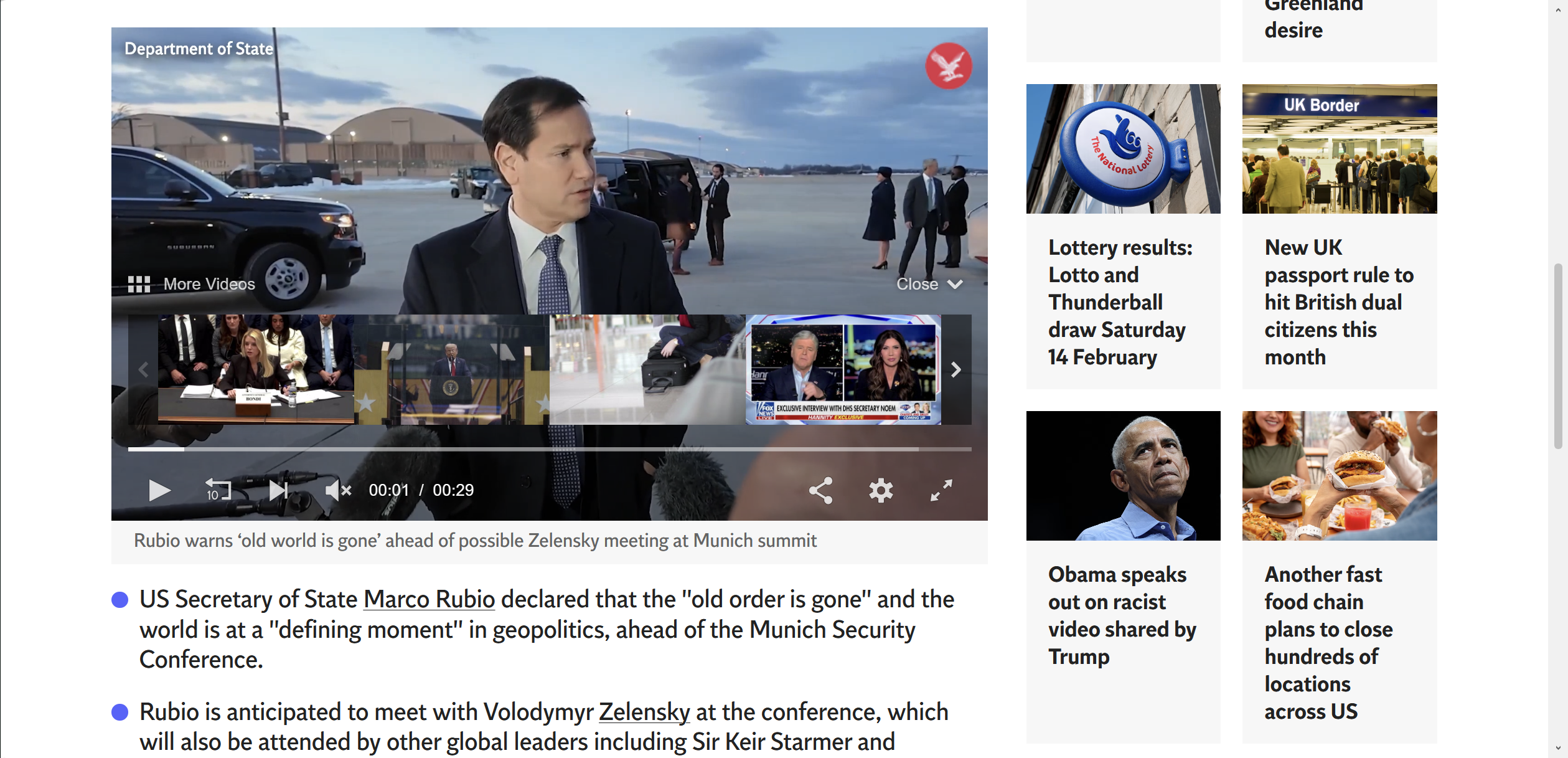
In politics today, the Independent, co.uk, would fancy US Secretary of State Rubio as saying, “old order is gone”, whereas he clearly says “the old world is gone”. Why the fancy?
First, there are the stories of the new world order as “foretold” in the US Great Seal. It might be that the Seal ■does not say that exactly.
Second, an order gone might figure with the brochure above exactly, where supposedly Confucius “with great bitterness of spirit, lamented the disorders of his time”. The grief is rendered on page 41: “O great Mountain, what art thou become! This important machine is subverted!”
Here is Mr. Rubio: https://cdn.jwplayer.com/previews/QnHWtAvQ.
The Sun is plainly a physical factor, as schools can tell. Otherwise, we might fancy the star wandering around Earth as well, after a regular pattern still, where sooner or later, having been on the side of London and also Peru, it comes to be on the side of Moscow. Only, would they make anything like ■Eliaia.
(Work in progress.)

 TERESA PELKA.COM