Philology is knowledge on words, how they get to be spoken or written, how they happen to become human thinking matter; words in their making a natural language, in texts old and in texts new.
The Greek philos and logos have been together to tell, love of mind and language is the sense of this field of human activity. There is no requirement for a ■Sentimentalist flair: love is simply an elegant shape for a word (■filia), and minds never are fond of affective disorders (■logos). Regarding an idea ugly as a mind without natural language — love is dainty.
There are other concepts:
“What is philology? The three ladies depicted here are, from the left, Grammatica, equipped with a cane to thrash the student on front of her if he did not learn his daily portion of morphology, syntax, style, and metre, then Dialectica, carrying as her attribute a snake which symbolizes her cunning and occasionally perfidious way of arguing, and finally Rhetorica, wearing a shield…”, ■Five Contributions to Latin Philology.
I agree with Benjamin Franklin and Thomas Paine, classicist methods have not been a happy design. Labels as “sadomasochism” or “psychopathology of everyday life” might apply, to canes that thrash; they cannot be love of mind and language: some people understand quotient as a capacity for solving problems, and some for skill in not having those. ■Travel in Grammar opts for the latter; my early and happy design, it is painless.
History has known ideas pretty and ideas scruffy, the key concept to have been a ■rim. Throw philosophy, politics, and war into one goblet, here comes Friedrich Nietzsche, with his looking around if there is anything above. In another cup — politics, fable, and war amalgamate into the bubbly tales by ■J.R.R. Tolkien. It would have been a simple tumbler, for colonial politics to have swollen up to the brim with the Proto-Indo-European theory by ■William Jones, neither stem nor foot, for a man, woman, child, or a house.
Feel welcome to read:
■No man, woman, child, or house, with the PIE.
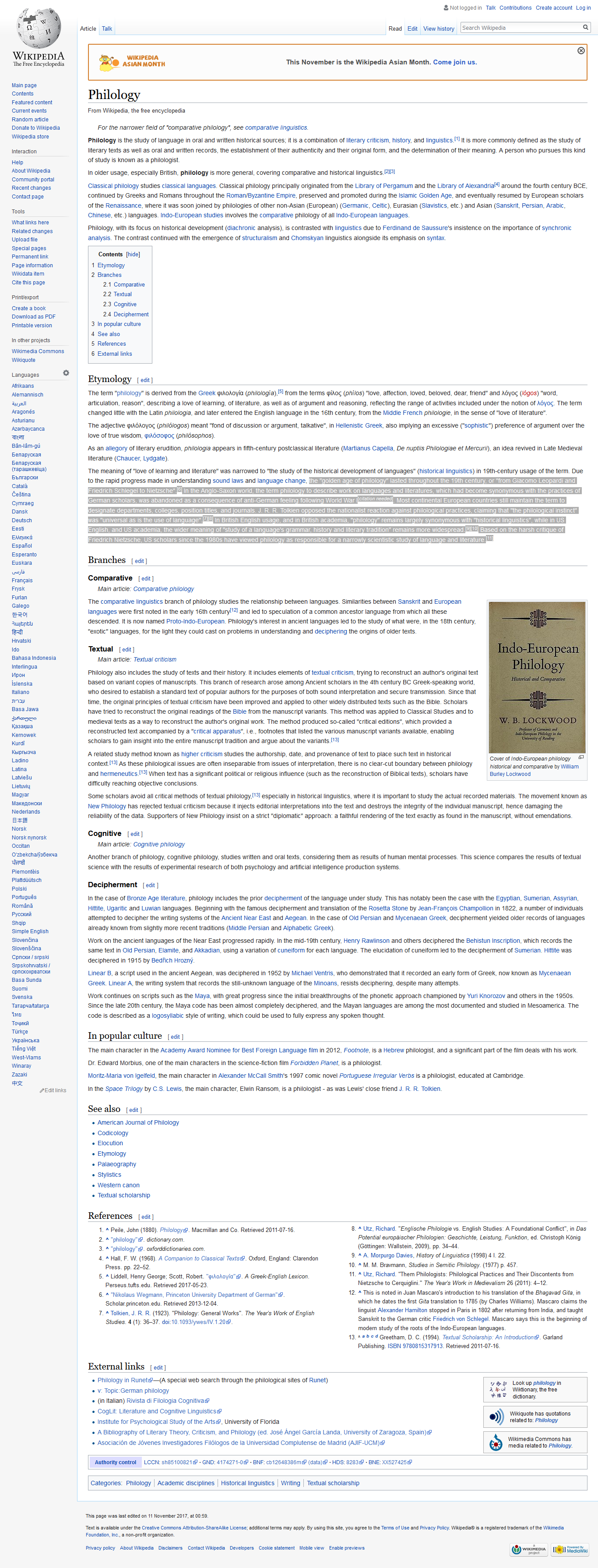
The mixtures did not turn out as agreeable as the idea for the American ■melting pot, and philology got worse than adulterated. Here we have Wikipedia on ■philology:
The “golden age of philology” lasted throughout the 19th century, or “from Giacomo Leopardi and Friedrich Schlegel to Nietzsche”. In the Anglo-Saxon world, the term philology to describe work on languages and literatures, which had become synonymous with the practices of German scholars, was abandoned as a consequence of anti-German feeling following World War I.
Based on the harsh critique of Friedrich Nietzsche, US scholars since the 1980s have viewed philology as responsible for a narrowly scientistic study of language and literature.
I do not know any rationale for a word as “scientistic”, and facts in my philological work ■here are sure scientific enough. I cannot think about a reasonable quote for the “Anglo-Saxon world” either, and it is not only because physicists continue to make careers, despite the nuclear experience of World War Two.
I have always wanted to be a philologist — my interest in languages began naturally and early in my childhood — I want to remain a philologist, and I honestly do not understand why Nazi especially ideas would occur about the study and works. Philology is nothing Nazi. It is in Poland, England, and many other countries, not only in Germany. ■Champollion was a philologist — and a Frenchman. I have never done anything Nazi and I have never liked Hitler. Feel welcome to see the course when I studied, ■philology, curriculum.
I have never read any work by Nietzsche, and I continue to need a spellchecker for the name: it must be I do not care to remember, having looked through a few passages of his Zarathustra: I didn’t get to like the style and mind manner — either lazy or otherwise incapable. Zarathustra (copy and paste, because I do not care to type this) is one of those books I’d have to be paid to read.
I have checked briefly on Nietzsche’s career. He became a classical philology professor at a very young age, 24, without doctorate, recommended as “a phenomenon” by ■Friedrich Wilhelm Ritschl. “Without a special tendre”, but ■Prussianism became of mention in the letter, and the motivation to promote Nietzsche might have been political as well as private. Nietzsche never presented his doctoral thesis and his promotion was against school rules.
Only a year later he left the school and joined the Prussian army. Four years later, he decided to turn to philosophy. He had his first noted nervous breakdown in 1889. Previously, he had used big amounts of opium and chloral-hydrate, having suffered from visual distortions, headaches, and indigestion since childhood. He died in 1900, after two strokes, aged 44.
Nietzsche’s ■Übermensch would maybe belong with some poor quality philosophy, but never with philology. I have never met anyone who would have Nietzsche for an influence. I was born in 1970, and celebrated my American English philology graduation with ■champagne, French of course.
On the side of mental health, the philologist advantage is that you cannot drive him or her insane with words; for other methods, other people go mad with them too, and philology cannot take the blame.

To talk about philology per se, without other pursuits, an honest lexicographer might shrug in disaffection to a theory of a universal instinct, unless the day would be bad for nonsense. The theory was coined by Tolkien, yet instinct alone is never enough, even if only to pronounce words. We may compare the word shape “czar”, for a ■Russian autocrat in English, and a ■charm in Polish. Man needs knowledge.
A reliable etymologist likewise, might frown to an “ancestor” language where words for men, women, children, and houses do not even resemble the “offspring”. People have kept these word shapes throughout ages, and if there are no similarities, the languages certainly do not come one from another, or from a source in common.
Well, and word shapes happen to change in sense. We may compare the Middle English ■hate, when the day is bad for nonsense.

To conclude, people are people. We do not go for a refund to another baker — or a babiche handyman maybe? — if the local bread is too salty. It is not for some association with salt, is it? That would rub in any apparel for the foot.
Philological works should be assessed individually, and certainly not with regard to works of other extents, as philosophy of poor quality.
I do not know those German philologist methods that Wikipedia would hold in contempt. The manner I have been familiar with is “to make it all check out with resources”, and this cannot naturally cause any contempt.
Philology is not a secret fraternity, and if people make an environment, it is the same as with other professions, where people differ and compete. The quote above comes from a work by Richard Utz, who titled it “Them Philologists”.
The truth and fact remain that all language study in depth will be philological somehow, so if a person likes a language really, they go study philology, because there is nowhere better. Stigmatizing this pursuit of knowledge with allusions to Nietzsche is not honest.
A philologist may also create own resources and express own opinions, which he or she then marks with own name. Feel welcome to my ■American English generative grammar: it works with all standard American, and checks out with plenty of resources, ■COCA is only one of many.
Regards, Teresa Pelka.
Resource for Emily Dickinson’s poetry

The epsilon, predicate structure, vowel contour, phonemics, person reference in abstract thought, and altogether stylistic coherence, for manuscripts and print piece-by-piece. ■More
Poems
Life | Love | Nature | Time and Eternity
NOTE
J. R. R. Tolkien wrote “the philological instinct” was “universal as is the use of language”. Wikipedia, Tolkien, J. R. R. (1923). “Philology: General Works”. The Year’s Work of English Studies. 4 (1): 36–37. ■doi:10.1093/ywes/IV.1.20.
My graduated major is psycholinguistics, but it is “linguistic psychology”, studied at a philology department. There is also psycholinguistics at psychology departments, and this happens to be something much different at times: there, the major is psychology, without university specialization at language really.
■Frontiers at Psychology uses an unacceptable term, “some deviant property of the linguistic stimulus”: linguistically, you do not expect of human evolution to excel ants — in marching one direction, as ants happen to take a few, or even go “to and fro”; there must be some other things. To use the term “deviant”, you need to state from what quality to note that departure, and how. One ideal speaker for the world entire would be against the first amendment.
There is no singular brain area to be a “parser” alone. People are not parsers, people have personalities, and more, more, more differences.
Even if people were parsers, I’d say, I can do that on my own (■The fable of philosophers Shapely and Handsome), so why hurt the fella (provided I wouldn’t be martyred for that, of course; in that case, take the fella). There’s really no such singular region or area in the brain to be parser, so you’d be imposing on the guy’s brain, which I do imagine for infliction of pain, though psychological. Me, I first and foremost do not trust anyone as to delegate any part of my work, so forgive me, I am not going to take any guy.
On the other hand, if you just do it yourself and you use your brain entire, linguistic parsing is just thinking about language, and if you have knowledge, the brain gives you pleasure for that, so why shouldn’t I do it myself. Maybe it’s only not nirvana, whoever knows what nirvana is really; or, maybe it is a kind of nirvana, — religions could involve observation on the brain.
To look for a parser in a human brain: honestly, it looks more of a study to seek a mode for computer processing; in which case you need legally written informed consent, or you sit your own bottom on a chair or like, and you do all from beginning to end, to be respectable whatsoever. A “parser” — it is so dehumanizing. You could only be cheating people into pseudo-therapies for another purpose, as software development for financial gain, and it’s just about your cash. I’ve never cared to be pattern for software.
Freud quite evidently partnered with early radio; made some cash, but stood no chance to be respected long-term objectively as for science. There’s been opinion about him, he should’ve been an archeologist. Archaeology is about fact as artifact too. Truth. is next door, with philosophy (Indiana Jones got it with dignity). Without the radio, many things wouldn’t have happened at all. The “facts” wouldn’t have emerged.
You still don’t get many people today to want to know how it is to be hungry: just grab something to eat; nothing to go for in hunger. If you hit someone hard on a leg, the bone may break. Should it, the fact will be the bone was — or is — broken. The truth will remain the bone never would’ve been broken without the hit. Fact and truth can get along with common sense too.
Nazis did radio experiments in concentration camps, possible, also clarifying on things for themselves from before the war. People would have never had the damaging experience, the truth remains about anyone in case also today. I saw a movie, a woman didn’t want to speak about those impressions in a concentration camp, many years after World War Two, in 1990s. I never was curious about anything as bad. It’s enough to know it was radio frequency experimentation, microwave or RF.
■Hertzian optics, Wikipedia
Well, and I’m never going to care to have a humanoid computer. R2D2 looks great for dusting and laundry; could talk, with simple computer talk turned on. No radio can become my ■intrinsic feedback. Philology has helped me shape skill I can turn into money with my own work, without going to other purposes ever. This feels good. It’s dignity too.
■Psychology Today: Researchers use constructed languages to probe how we learn grammar rules.
This is exactly how people do not learn grammars. Only virtual or invented words belong well with natural language acquisition and learning, feel welcome to see ■here. There might be no one on Earth today to have learned own everyday grammar from constructed languages. Nobody. ■Niente, to learn natural languages.
Finally, sex is really not a term of linguistics. There is grammatical gender or simply gender. My principle is not to go that other camp, even if they need a nanny. Their thing can be only about their cash, because the semantic field is not mathematics, and this shows already with the comma (■The commatoform disorder), and there is still ■color natural green, where to postulate an algorithm is as to profess eternal divisibility of matter with exceptions. With regard to cash, I have my own and reasonable ideas.
■This text is also available in Polish.
The world may never have seen her original handwriting, if her skill was taken for supernatural. Feel welcome to Poems by Emily Dickinson prepared for print by Teresa Pelka: thematic stanzas, notes on the Greek and Latin inspiration, the correlative with Webster 1828, and the Aristotelian motif, Things perpetual — these are not in time, but in eternity.
■PDF Free Access, Internet Archive


 TERESA PELKA.COM