Every human being is god himself, but it does not understand its true self, and it is constantly engulfed by the influence of its mind, its intellect, which you call as a great illusion, says Vamsi Krishna.
We can view
“The Awakening of a New Wave of Consciousness” on YouTube.
■This text is also available in Polish.
The sense of Mr. Vamsi’s words in English is that everybody is god, but nobody knows own true self or god part, because every person lives under own mind or brains, and these are illusions.
“To children, a rainbow is something vivid and real; but the grown-ups know that it is merely an illusion caused by certain rays of light and drops of water” — is a quote from a Buddhist teaching to deny people have souls.[1]
■Rainbows are physical phenomena and thus they are absolutely real, only not easy to touch. To say a rainbow is real does not prove the human soul — the spiritual dimension would not belong to the physical world — yet in the first place, it is the Buddhist who should not contend rainbows.
Whether a human being would be saying everybody is god (to be is a word in a dictionary), or that human souls are not physical and thus are not existent (languages and dictionaries for existence too), unless the person wants to beguile us, they think what they say.
The verb to be is an exquisite test on ideas. For anything to exist, it needs to be. ■Vocabulary here can be of help, to consider ■Anatta or another Buddhist belief with regard to the verb. Let us mind, entire collections of teachings were attributed to Siddhartha from reportedly a tradition that was ■spoken, and ■first committed to writing about 400 years after the Buddha’s death. The copies people have today are still younger and by no means ■autographs by the Buddha or his disciples.
Even the Buddha’s language is uncertain, speculation pointing to Middle Indo-Aryan dialects and particularly ■Pali. The time the writings emerged is not known. It might have been late Middle Ages: the ■Middle Indo-Aryan period ended around 1500 after Christ.
■Upanishadic concepts are worded today as,
□ All psycho-physical processes (skandhas) are impermanent;
□ If there were a self, it would be permanent;
□ If the self existed it would be the part of the person that performs the executive function, the “controller”;
□ The self could never desire that it be changed (“anti-reflexivity principle”);
□ Each of the five kinds of psycho-physical elements is such that one can desire that it be changed.
The Upanishadic conclusion is ― There is no self.
A skandha means a heap, aggregate, collection, or grouping. In Buddhism, the word heap refers to five aggregates, says ■Wikipedia, that “constitute and completely explain mental and physical existence of sentient beings”. You add up the five or merge them and you get a human being, they say.

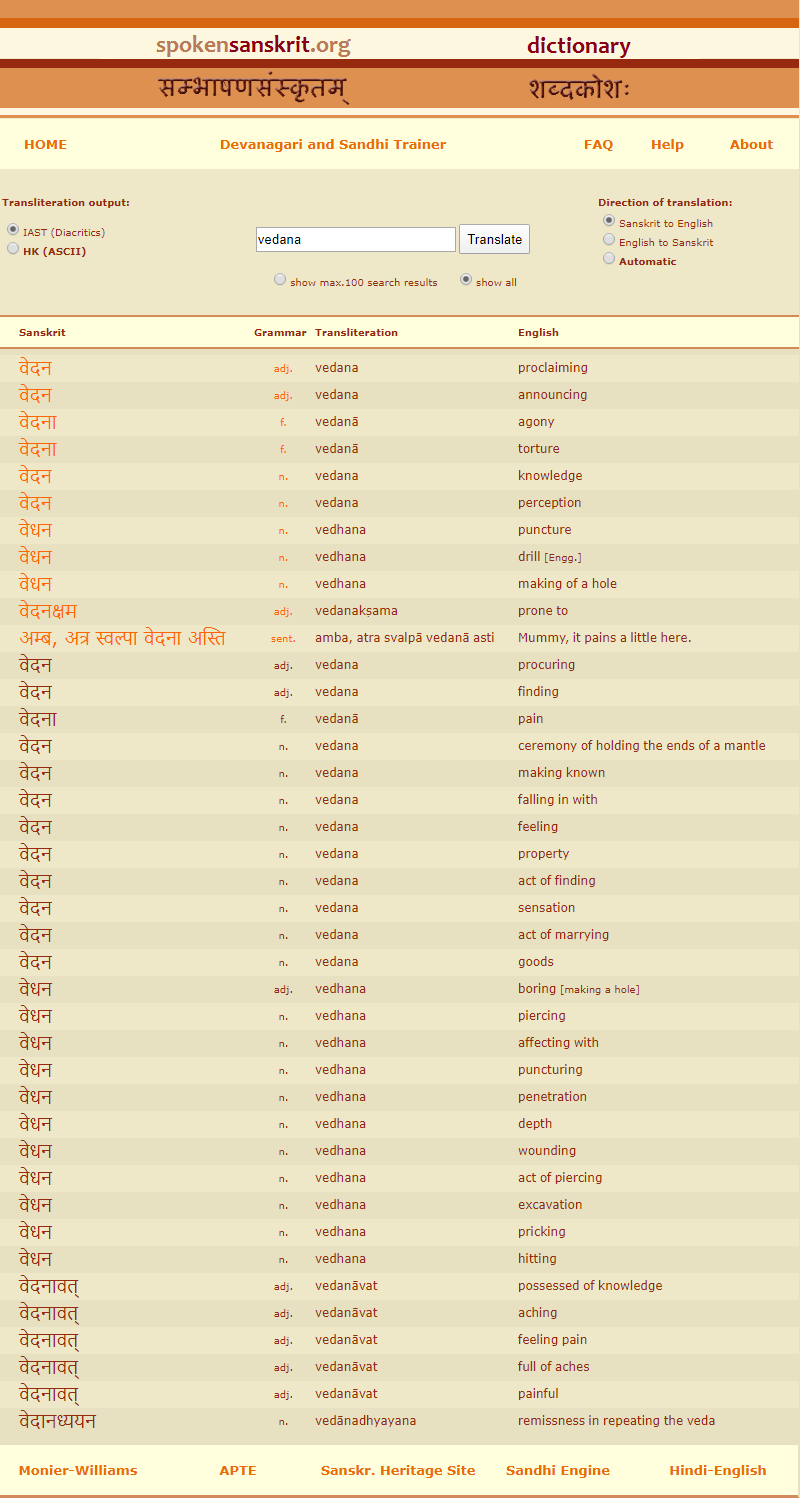
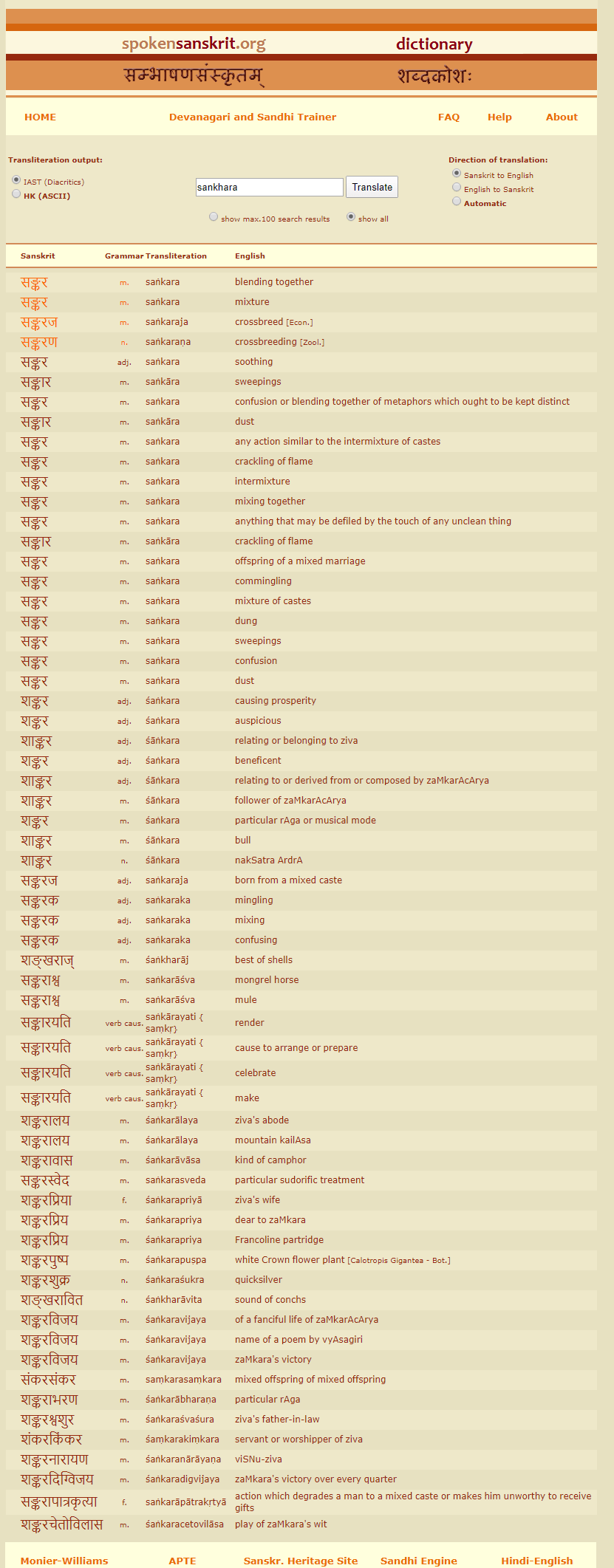
These five Buddhist aggregates or heaps would be: (1) rupa, the form, matter, or body; (2) vedana, sensations or feelings received from form; (3) samjna, perceptions; (4) sankhara mental activity or formations; (5) vijnana, consciousness.
(1) The first skandha brings form, matter, and body under one term, rupa. If I carved a real word of whatever real language in wood, and then I also wrote it in ink or printed it out, it would remain the same bodily representation in form, but it would be different material realization. The skandha does not make a coherent idea, therefore, there is not really a way to use the verb to be for it. The skandha does not truly exist, is the conclusion.
(2) The second skandha generalizes feeling and emotion into “sensations received from form”, vedana. Since the Buddhist form would belong under the same term with body and matter (rupa), a prod would be the same as a sentiment, whereas feelings are not vegetative. Esthetic pleasure is not the same as ■somesthesia, and it has been one of the most powerful motivating factors in human history and civilization — the verb to be would break the skandha into at least two ideas. This skandha is not truly real either.
(3) The third skandha separates perception, samjna, from (4) activity of own mind, sankhara, and (5) consciousness, vijnana. Since there would be no point discussing perception in an anesthetized human being, the verb to be does not apply as well.
The word ■gautama also means poison, and so the vocabulary brings juxtaposition; we may compare the Spoken Sanskrit for ■skandha, ■rupa, ■vedana, ■samjna, sankhara, ■vijnana.
The word form “skandha” alone may bring meanings as a branch, a war, or evil — as well as religion. Skandhā-pasmāra may mean a demon causing a particular disease, and skandha-şaşthīvrata may indicate a particular religious observance. The skandhas do not look ideas to say “this is the thought”.
ADVERTISEMENT
Notes for Emily Dickinson’s poetry

Fascicles and print, the poetic correlative with Webster 1828, Latin and Greek inspiration, an Aristotelian motif, Things perpetual — these are not in time, but in eternity. ■More
Poems
Life | Love | Nature | Time and Eternity

Most people allow for afterlife. Considering oneself a biological robot is not really agreeable — it is not a thought. Everyone knows that physical mortality is certain; but there is no knowledge to say unearthly existence is impossible.
Alfred van den Bosch has the word love for a generic idea for hope:
Love is the glue of the universe, he says.

David Icke would embrace all with impersonal “cognizance”: everybody lives as droplets in an ocean of consciousness, he claims.
And all it is, as everything else is, a choice. A choice between fear and love, says Mr. Icke.

He would be a book classic for a bipolar disorder, but mental care has been spotted for political involvement. Literature can be the neutral ground to note that Mr. Icke is most likely the first Briton to claim that Shakespeare would not make it even for a fish pond. Droplets, he says.

The fear is a lack of being all-powerful. Being anything less than an infinite love, puts us into a state of fear, says George Neo.
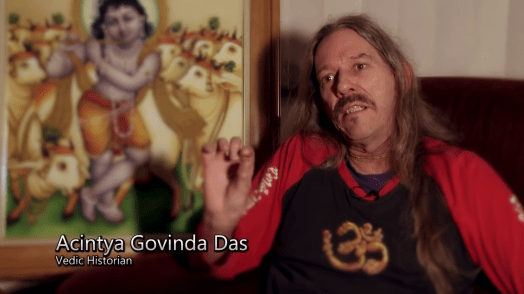
Acintya Govinda Das, an Australian Vedic historian, explains how the Earth continues to transition through Iron, Bronze, Silver, and Golden cycles:
In the Silver time, evil lives over the ocean. In the Golden, evil goes to live on another planet, and people get a lot of that Gold.
The story of metal times is reminiscent of the ■edict of expulsion, by English king Edward I. Evil living in people can be your metaphor, if you are ethnically intolerant and live in an environment of ethnically changing proportion. The king banished Jews because they had too much cash to his taste.
Only “seriously mystic Yogis” are to live in the Golden stage, says Mr. Das, but to get there, you need to mind who could be “meddling with your mind”. In this context, the movie shows the US Great Seal.
We have to become aware of who’s meddling in our minds. Our mind is our biggest problem, when it is not under our control, says Mr. Das.
Fell welcome to read ■A New People, about the USA Great Seal. There has been a degree of misunderstanding about the motto, but the Seal actually only tells a new nation has become: nothing to befuddle minds.
A New People
Out of one, many, says the sibyl by Virgil. Out of many, one, says the USA Great Seal. ■More

Mr. Bonacci says that death of the mortal body is a “non-event”.
If we continued to teach our original, nature religion, and we didn’t stop with the advent of Christianity, we would know that death of our mortal body is a non-event, he claims.

Gregg Braden purports that people watching the news on September 11 produced an emanation that altered the Earth’s electromagnetic field. He shows a graph, and he says it is a classified reading in nanotesla by NASA.
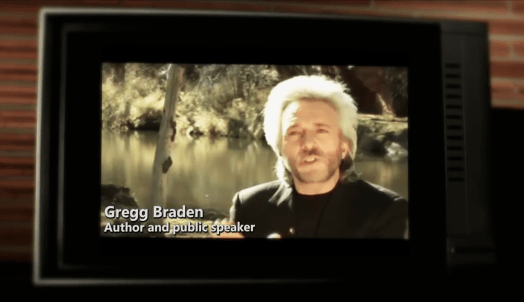
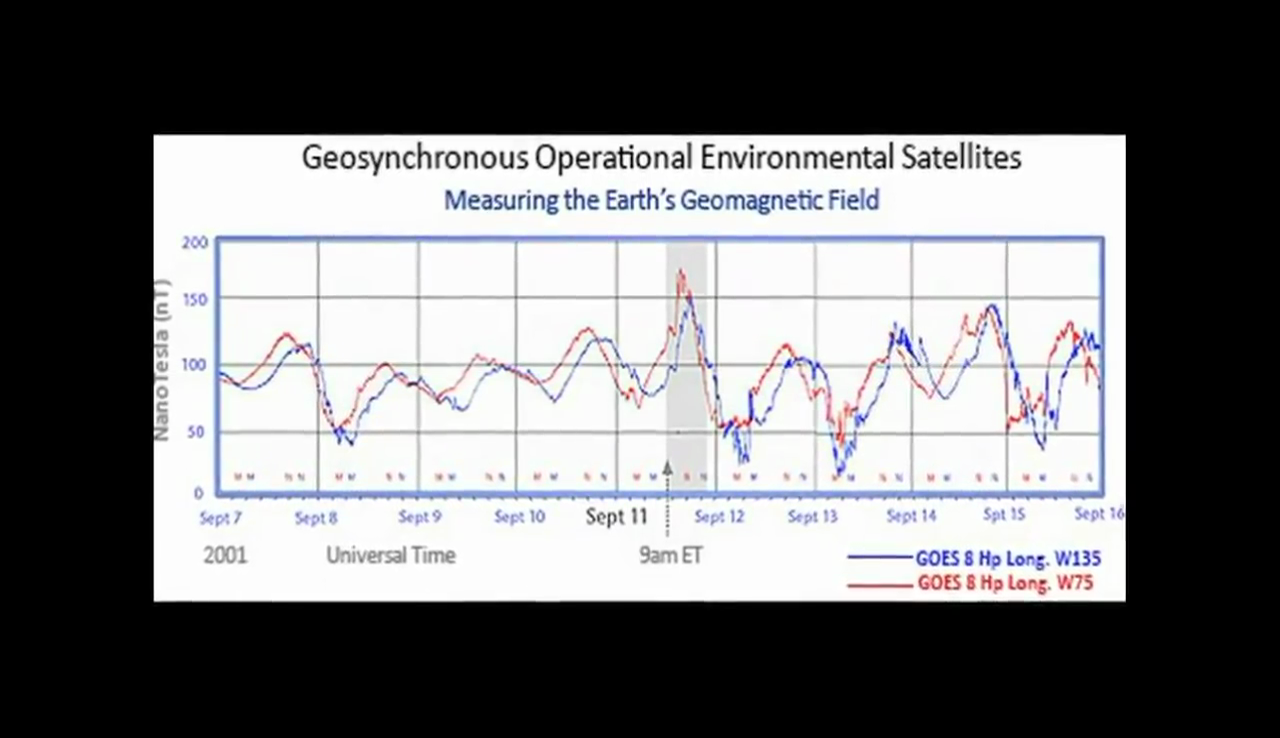
I have never had access to secret or classified data, but I also never have seen a “NASA anonymous”, that is, an illustration or graph without a note on the author(s) or agency. I browse pictures of the cosmos sometimes, to relax; all your problems on Earth look smaller.
■Nano means one billionth. The MRI spectrum is 0.5 to 3.0 tesla, or 5-30 gauss, for brain cellular function imaging. The human being would not make a proud comparison against an electrolytic battery, if you want Gregg Braden’s quantities for the result.
On the cellular level, Bud Barber says he can perceive cosmic energies as vibrations in his body.
The reason (for cosmic impulses) is the same a cell in your body puts out vibrations, within that cell, to make sure that the cell is a whole, is “operating on the same page”, he says.

On the side of desirability, Vamsi Krishna admits there are adverse effects:
…a human being is “bombarded” with unwanted thoughts constantly, during the day, which depletes his mental energies. It causes a drain of physical energy.
The sake of objectivity requires that I mention microwave technologies, only recently to have become revealed to the public. Some of the experiences described above, as influence inside own body or exhaustion, do match descriptions of microwave effects.
Feel also welcome to read about Poland, ■The toolbox republic.
…There is nothing more to us than just those skandhas, Wikipedia quotes Mark Siderits.[2]
Buddha starved to meditate, and the spoken tradition tells he even fainted during the practice. His observations might have been early reasoning on stochastic and deterministic modes of brain neural networks. The modes are recognized today for standard human neurophysiology, because it is enough to focus to perceive them, without hunger, stress, vibration, “bombardment”, or any religious reference. Feel welcome to try:
■Grammar Weblog, Mind practice.
And the human ego or self? A starving person may lose his or her somesthesia. Dependent on translation, if you say there is no self anymore, you could be telling you cannot feel your body anymore, as when fainting. What is certain, you need own soul, own spiritual self that is, to have afterlife at all.

Endnotes
[1] What Buddhists Believe: Is There Eternal Soul? Screenshot | live page.
[2] Buddhist philosophy, Mark Siderits: “What the Buddhist has in mind is that on one occasion one part of the person might perform the executive function, on another occasion another part might do so. This would make it possible for every part to be subject to control without there being any part that always fills the role of controller (and so is the self). This would explain how it’s possible for us to seek to change any of the skandhas while there is nothing more to us than just those skandhas.” Screenshot | live page.
Mr. Siderits would make spirituality all bodily. Compare ■Human brains, parameters, and devices: the brain does not have a superior structure we could call “the boss”. Brains make inner networks. One time, one network or its part is more active. Another time, it is another network or part of a network.
True spirituality cannot be bodily. Feel welcome to philosopher Honeybee, while there is Thomas Paine too: the graceful pride of truth knows no extremes, and preserves, in every latitude of life, the right-angled character of man; Rights.
The fable of philosopher Honeybee
Philosopher Honeybee did not consider it impossible, that all humanity could be more or less free of demerit one day, he yet never cared to proliferate evil in order to help keep the shape of the world. ■More

 TERESA PELKA.COM