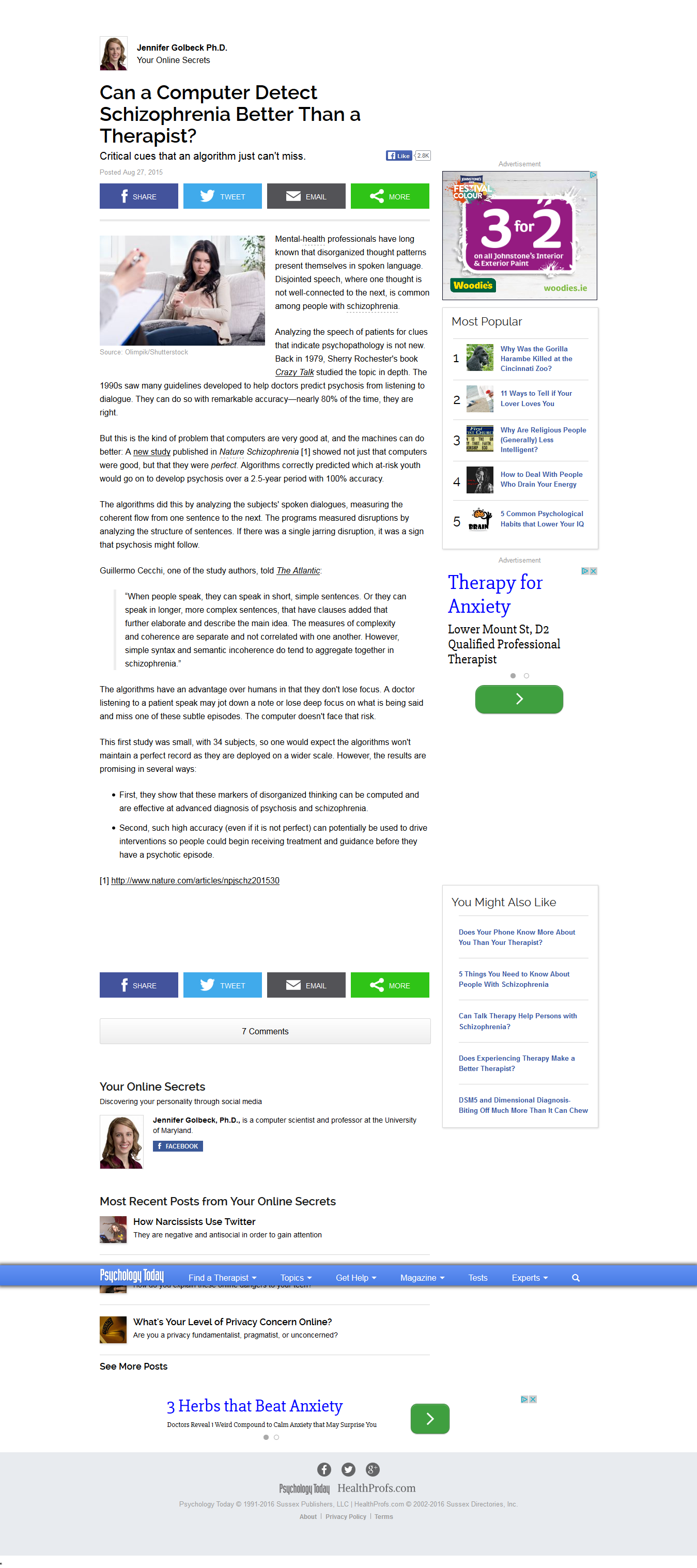
A computer program is now able to predict psychosis simply by observing language patterns, and with 100 percent success. Humans have been only 79 percent successful with that, tells a ■report by RT News, a license by TV-Novosti.
“Mental technology” has become a predilection by more than one party. US medics have some news too.
The power of ELM to provide quick but near optimal solutions to the training of Single Layer Feedforward Networks (SLFN) allows extensive exploration of discriminative power of feature spaces in affordable time with off-the-shelf computational resources, we can read over ■PubMed.
ELM is short for an Extreme Learning Machine. ELMs can prime artificial ■feedforward networks; ELMs are “pre-programmed, fast, and affordable”.
Artificial feedforward control behaves in a predetermined way, opposite to processing that has feedback. Human brains rely on own, intrinsic feedback, and the feedback role approximates a drive, believably for the sake of the self-preservation instinct; the tissue uses feedforward, but not in “single-layer networks” (■Neurophysiology of feedback).
ELMs are to work in Computer Aided Diagnosis of schizophrenia, though their mode is opposite to that of the human brain. ELMs are pre-programmed where the brain uses feedback; programs are closed-loop, feedback is open-loop.
Are computers good enough at language, to provide prognostics? Let us try machine translation. Poetry is normal language, only consummate. Here is Emily Dickinson’s ■Lost, and the Google says it is Google Translate: not “an assistant”, as software happens to be called, or another tool ancillary to translation.
I lost a world the other day.
Has anybody found?
You’ll know it by the row of stars
Around its forehead bound.
The pyxie would be a “he” and lose the world rather than a world

Polish does not have the articles, the words a, an, or the, but it does not neglect grammatical determinateness. To say “a world” in Polish, we need to modify the noun. “Świat” alone is “the world”.
Świat jakiś zgubiłam, dni temu parę.
Czy znalazł go ktoś?
Rozpoznać po gwiezdnym rzędzie się daje
Na czele i w krąg. ■Zawieruszony
With natural languages, we can have back-translation. The human translator receives the original and translated text, to back-translate for verification. Here is the computer back-translating itself.
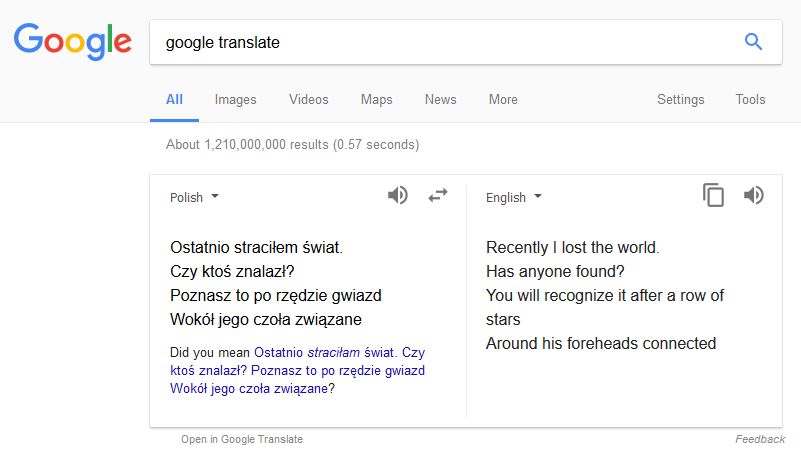
The forehead in the verse is a metaphorical “forehead of a world”. The bogey does not manage with the metaphor, and makes a masculine world in American, trying to tie around many heads.
Polish has collocations as “around the head” (wokół głowy) or “on the forehead” (na czole), but not “around the forehead” (*wokół czoła) — yet the pixie does not mind the hint of macabre.
Let us compare a few more lines.
May it be ■The Wind now.
Of all the sounds despatched abroad,
There’s not a charge to me
Like that old measure in the boughs,
That phraseless melody
The wind does, working like a hand
Whose fingers brush the sky,
Then quiver down, with tufts of tune
Permitted gods and me.
Here, the computer would send sound to foreign countries, to announce legal charges — it must be some AI criminal intent: ■PWN Translatica, Zarzut, Accusation.


Translation software is a good thing as help in formatting; it can spare one some time, filling in typical items as dates, or storing specialist words. The machine yet never has the decision-making that natural language requires.
For an exercise, I happened to throw in the machine and translate on my own — never allowing myself to be the same as the thing. Language is a vast dimension indeed: there is always another way to say something. Only the word level may remain, yet only at times. I tried that on the Rights of Man by Thomas Paine.
The original
Among the incivilities by which nations or individuals
provoke and irritate each other, Mr. Burke’s pamphlet on
the French Revolution is an extraordinary instance. Neither the People of France, nor the national Assembly, were troubling themselves about the affairs of England, or the English Parliament; and that Mr. Burke should commence an unprovoked attack upon them, both in Parliament and in public, is a conduct that cannot be pardoned on the score
of manners, nor justified on that of policy.
There is scarcely an epithet of abuse to be found in the English language, with which Mr. Burke has not loaded the French nation and the national Assembly. Everything which rancor, prejudice, ignorance or knowledge could suggest, is poured forth in the copious fury of near four hundred pages. In the strain and on the plan Mr. Burke was writing, he might have written on to as many thousands. When the tongue or the pen is let loose in a frenzy of passion, it is the man, and not the subject, that becomes
exhausted.
Google Translate
Spośród nieuprzejmości, którymi narody lub jednostki prowokują i irytują się nawzajem, broszura pana Burke’a na temat rewolucji francuskiej jest niezwykłym przykładem. Ani Lud Francji, ani Zgromadzenie Narodowe nie zajmowały się sprawami Anglii ani parlamentu angielskiego; i to, że pan Burke rozpoczął niesprowokowany atak na nich, zarówno w parlamencie, jak i publicznie, jest zachowaniem, którego nie można wybaczyć ze względu na maniery, ani usprawiedliwić ze względu na politykę.
W języku angielskim trudno znaleźć epitet obelżywy, którym pan Burke nie obrzucił narodu francuskiego i Zgromadzenia Narodowego. Wszystko, co mogłoby sugerować uraza, uprzedzenie, ignorancja lub wiedza, jest wylewane w obfitej furii blisko czterystu stron. W napięciu i planie, jakie pisał pan Burke, mógłby napisać jeszcze tysiące. Kiedy język lub pióro puszczają luz w szaleńczym namiętności, to człowiek, a nie podmiot, staje się wyczerpany.
Me
Pośród aktów braku ogłady, jakimi narody bądź i pojedynczy ludzie się wzajem prowokują i drażnią, pamflet pana Burke o Rewolucji Francuskiej jest przypad-kiem nadzwyczajnym. Ani Francuzi, ani ich Narodowe Zgromadzenie, nie zadawali sobie trudu dla spraw Anglii, czy jej Parlamentu; a niesprowokowany atak na nich przez pana Burke, w Parlamencie zarówno jak publikacją, jest sprawowaniem się takim, że się go wybaczyć nie da, ani na gruncie manier, ani we względzie linii postępowania.
Mało jaki pozostaje w języku angielskim obelżywy epitet, którego by pan Burke nie wymierzył we francuski naród i Narodowe Zgroma-dzenie. Cokolwiek rozdrażnienie czy przesąd, bądź też ignorancja jako wybór wobec wiedzy, byłyby w stanie na myśl nasunąć, tu przelane jest ze szczodrą furią na blisko czterysta stron. Przy zawzięciu i zamyśle z jakimi pan Burke pisał, mógł był napisać stron i parę tysięcy. Jednak gdy szał i gorączka ponoszą język lub pióro, wyczerpaniu ulega człowiek, a nie przedmiot opisu.
I am opposed to using or, actually, abusing language for a diagnostic in mental disturbance. It might be murder on literature as well as language personal styles. Mental disorders are not speech disorders or speech-related defects, where you could use linguistic tests justifiably.
Google Translate has been ruled insufficient for expression of legally consent: ■Court Says Google Translate Isn’t Reliable Enough to Determine Consent for a Search.
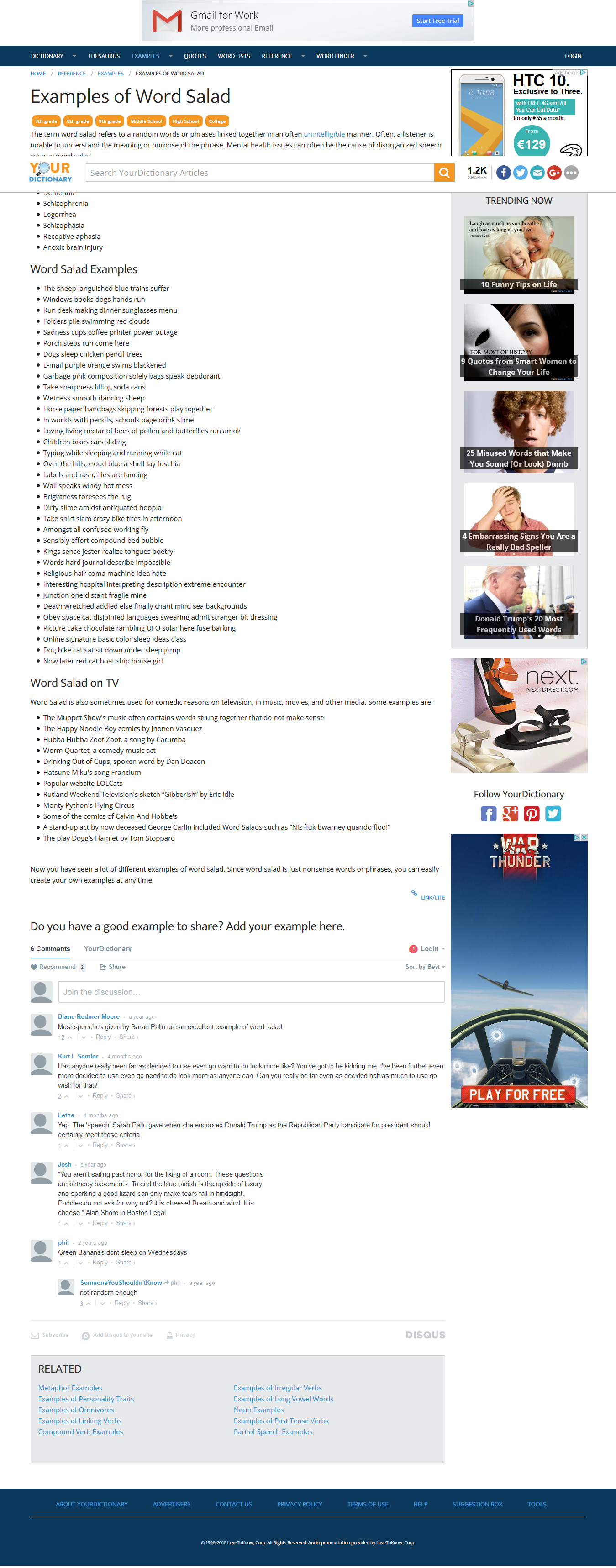
It is true that schizophrenia may develop into schizophasia, that is, phonologically driven discourse. The person would be “following speech sounds” and not word sense. The example of word salad here would show a recourse to the hard palate (sadness-outage): sadness cups coffee printer power outage
However, if it occurs, schizophasia comes in late stages of the illness. Diagnosis would come sooner, therefore, language would not be a diagnostic. ■Examples of word salad.
As Vander and others published in 1985, neurological research redefined schizophrenia as a somatoform disorder. Neuro-imaging detected differentiative biological structuring in patient brains. Studies implied a developmental background, as a viral infection, malnutrition or other, during fetal or early post-natal life, for ■the climbing fibers. The findings were not to encourage preemptive diagnoses. Computers were used to provide neuro-imaging, but they were not trusted on diagnosis or prediction.
The imaging obviously could be useful in avoiding mistakes, as diagnosing people under circumstances many as they can be today, or those with PTSD, as schizophrenic.
Let us note, diagnosis with schizophrenia can result in loss of property, forced isolation, and medication. Words as “psychosis” or “schizophrenia” might become “heavy weaponry” if abused, and this is the light in which to see projects to “foretell” mental disturbance in young people as well. About to enter a world that fears the machine, a sci-fi gruesome scenario today, the youth never could factor in spontaneity and progress, the way people think about young age at the present.
The Atlantic, ■How a Computer Predicts Schizophrenia and Psychosis.
Jennifer Golbeck, Ph.D., ■Can a Computer Predict Schizophrenia Better than a Therapist?
Medical News, ■Computer Algorithm Can Be Useful in Early Diagnosis of Schizophrenia.
■This text is also available in Polish.
The world may never have seen her original handwriting, if her skill was taken for supernatural. Feel welcome to Poems by Emily Dickinson prepared for print by Teresa Pelka: thematic stanzas, notes on the Greek and Latin inspiration, the correlative with Webster 1828, and the Aristotelian motif, Things perpetual — these are not in time, but in eternity.
■PDF Free Access, Internet Archive


 TERESA PELKA.COM